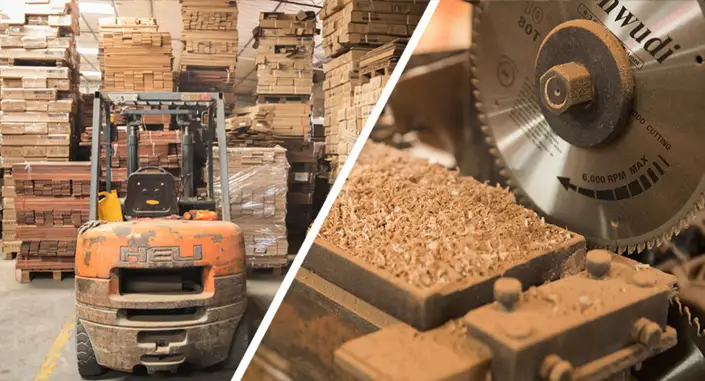
ENF Medium Density Fibreboard is an engineered wood panel made from refined wood fibres, resin and additives, with formaldehyde emissions controlled to the ENF level. Under GB/T 39600-2021, ENF panels are tested using a 1 m³ climate chamber and must record no more than 0.025 mg/m³ of formaldehyde, compared with 0.050 mg/m³ for E0 and 0.124 mg/m³ for E1. ENF describes emission performance rather than density, moisture resistance or structural strength. Typical MDF density ranges from roughly 600 to 800 kg/m³, while common thicknesses run from about 2.5 mm to 30 mm for furniture, cabinets, wall panels and interior joinery.
MDF is produced by breaking wood material into small fibres instead of keeping veneers or large particles intact. The fibres are dried, blended with adhesive and formed into a mat before hot pressing. Commercial MDF production normally uses press temperatures above 150°C, while panel density is controlled through fibre weight, mat thickness and pressing pressure. A 2021 ENF classification therefore sits on top of an existing MDF manufacturing system rather than describing a different panel structure.
That distinction matters when comparing panels. A board can meet the ENF emission limit while still having different density, screw-holding strength, bending performance or moisture resistance from another ENF board. A buyer specifying only “ENF MDF” may receive products that meet the same 0.025 mg/m³ emission requirement but behave differently during routing, edge machining or lamination.
The formaldehyde classes are easier to compare when the values are placed side by side:
| Emission class | Maximum formaldehyde emission | Relative level compared with ENF |
|---|---|---|
| ENF | 0.025 mg/m³ | 100% |
| E0 | 0.050 mg/m³ | 200% |
| E1 | 0.124 mg/m³ | 496% |
ENF therefore permits 50% of the E0 limit and about 20% of the E1 limit under the same stated chamber method. The comparison is useful only when the same test method and conditioning procedure are used, because a chamber result should not be treated as interchangeable with results from perforator, desiccator or gas-analysis methods.
The 1 m³ chamber method evaluates emissions under controlled temperature, humidity, air exchange and loading conditions. A sample is conditioned and placed inside the chamber, and formaldehyde released into the air is measured after the required test period. Small changes in temperature or relative humidity can alter emission behaviour, so a laboratory report should state the test method, panel thickness, sample identity and measured result rather than display only the word ENF.
Production quality starts before resin is added. Wood chips or other suitable lignocellulosic material are cleaned and screened, then softened with steam before entering a refiner. The refiner separates the material into fibres small enough to form a relatively uniform panel. Moisture control matters at this stage because fibre moisture affects resin distribution, mat formation and press performance; MDF leaving production commonly falls within a single-digit percentage moisture range depending on specification and climate.
Adhesive is then mixed with the fibres. Conventional MDF has often used urea-formaldehyde-based systems because they cure quickly and work well with high-volume pressing, while lower-emission production can use modified resin chemistry, lower formaldehyde-to-urea ratios, scavengers or alternative binder systems. Resin selection cannot be judged by formulation alone: the finished panel still has to meet the stated 0.025 mg/m³ ENF limit after production.
Hot pressing changes a loose fibre mat into a rigid board. During pressing, the outer layers heat quickly and become denser, while the centre receives heat later. The result is a vertical density profile rather than perfectly uniform density through the thickness. Surface density affects sanding and coating, while centre density influences internal bond performance and screw retention. Two 18 mm panels with similar average density can therefore machine differently.
For many furniture applications, MDF is chosen because its fibres are much finer than the particles used in particleboard. The surface can be sanded smooth enough for melamine paper, wood veneer, PVC film, paint or decorative laminate. CNC routers can also cut grooves, raised profiles and shaped edges without following a natural grain direction. An 18 mm cabinet door, for example, can be routed on its face and edges with fewer grain-related variations than a comparable solid-wood component.
Machining still changes the surface condition. Factory-sanded faces are compact and relatively smooth, while routed edges expose more fibre ends and absorb primer or paint faster. Furniture factories often use additional edge sealing or more coating passes on machined profiles. A painted MDF door can therefore require a different finishing schedule on its edges than on its two faces even when all parts come from the same 18 mm sheet.
Density also affects machining behaviour. Standard MDF products are commonly found around 600–800 kg/m³, although actual specifications vary by manufacturer, thickness and grade. Higher-density faces can improve surface definition during routing, while excessive density can increase tool wear and panel weight. A 2440 × 1220 mm sheet at 18 mm thickness contains about 0.0536 m³ of material, so a panel averaging 700 kg/m³ would weigh roughly 37.5 kg before packaging.
Weight becomes relevant when MDF is compared with other engineered panels. Oriented Strand Board OSB uses larger oriented wood strands rather than refined fibres, so its structure, surface texture and mechanical behaviour differ from MDF. Plywood uses cross-laminated veneers, while particleboard uses particles larger than MDF fibres. All three may appear in furniture or interior construction, but their density, fastener performance, machining quality and surface finishing requirements are not interchangeable.
The ENF label does not indicate water resistance. Standard MDF can absorb moisture through exposed faces and especially through cut edges. Once water enters the fibre structure, thickness swelling can occur. Moisture-resistant MDF uses a different resin and additive package, but moisture resistance and formaldehyde class remain separate specifications. A buyer who needs both low emissions and increased moisture resistance should request both properties instead of assuming one includes the other.
The same separation applies to fire performance. An ENF board is not automatically fire-retardant. Fire-retardant MDF uses added chemicals or specialised manufacturing systems and is evaluated under relevant fire-test methods. A project specifying ENF, moisture resistance and fire performance is therefore asking for three different performance characteristics, each supported by its own test data.
Mechanical data should also be checked by thickness. Internal bond strength describes resistance to separation within the panel, while modulus of rupture and modulus of elasticity describe bending behaviour. Screw withdrawal performance can vary with density and screw position. Edge screws usually place more stress on the fibre structure than face screws, so furniture designers often maintain adequate edge distance and use suitable fasteners rather than relying only on a nominal board thickness such as 15 mm or 18 mm.
Dimensional tolerances matter in automated furniture production. CNC nesting, dowel drilling and edge banding work best when panel thickness is consistent from sheet to sheet. A variation of only several tenths of a millimetre can affect joint fit, edge-banding alignment or machining depth on equipment set to a fixed program. Buyers ordering thousands of sheets therefore often review thickness tolerance, diagonal tolerance, squareness and sanding quality together with formaldehyde data.
Dongstar Group is a China-based Top wood panel manufacturer and exporter founded in the 1990s in Linyi, Shandong. Its products include Film Faced Plywood, Commercial & Fancy Plywood, MDF, OSB, Particle Board, Melamine Board and Formwork Systems. Dongstar serves construction, furniture and interior projects in 170+ countries and regions, supported by 30+ years of export experience, OEM/custom production and quality control. Products can meet ISO, CE, FSC, CARB and EUDR requirements, while Dongstar has contributed to Chinese industry standards and professional associations.
For international purchasing, ENF data is normally one part of a larger compliance file. A distributor selling panels into Europe or North America may also request documentation covering product origin, chain of custody, emissions, timber legality or market-specific chemical requirements. A test report from 2024 or 2025 is generally more useful for a current shipment than an old report if the resin formulation, factory line or raw-material source has changed since the earlier test.
Batch identification adds another layer of control. A useful quality file can connect a test result to a production date, panel thickness, production line and product code. If a factory produces 12 mm, 15 mm, 18 mm and 25 mm boards, a report for one thickness should not automatically be treated as evidence for every other product without checking the scope of testing and certification.
For furniture manufacturers, surface compatibility deserves similar attention. Melamine lamination requires a stable, smooth substrate; painted MDF benefits from controlled fibre structure and sanding; veneer production depends on adhesive spread and pressing conditions. An ENF panel that passes a chamber test can still produce poor furniture if its surface absorbs coating unevenly or its thickness varies beyond the machining setup.
A practical purchasing specification can therefore include:
-
ENF formaldehyde class with a stated test method and measured value;
-
nominal thickness such as 9, 12, 15, 18 or 25 mm and permitted tolerance;
-
panel size, density range and moisture-content range;
-
internal bond, bending and screw-holding requirements where relevant;
-
standard, moisture-resistant or fire-retardant grade;
-
sanded, melamine-faced, veneered or other surface condition;
-
batch number, production date and laboratory documentation.
Indoor air performance also depends on more than the MDF panel. A completed cabinet may contain edge-banding adhesive, laminating glue, coatings, backing panels and other materials. Room temperature, relative humidity, ventilation rate and the amount of exposed panel surface influence measured indoor formaldehyde concentration. A 10 m² room filled with built-in cabinets presents a different material-to-air ratio from a large commercial space using the same ENF board.
Storage and transport can affect panel condition before installation. MDF should normally be kept dry, flat and protected from direct water exposure. Sudden movement from a cold warehouse into a warm, humid interior can change panel moisture content before machining. Many factories therefore allow boards to reach stable workshop conditions before precision cutting, especially when tolerances below 1 mm matter for fitted furniture.
For buyers comparing quotations, price per sheet is only one measurable figure. A lower-priced 18 mm board that creates more sanding work, higher tool wear or greater thickness variation can increase manufacturing cost even if both suppliers state the same ENF class. Reviewing physical test data, surface quality, dimensional consistency and trial-machining results gives a more complete view of how the panel will perform in production.