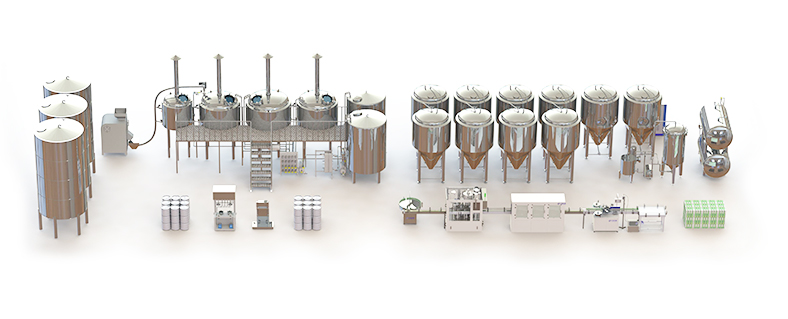
A turn-key brewery can reduce installation time by moving engineering, assembly, wiring, piping preparation, and equipment testing from the brewery site to the supplier’s factory. Instead of coordinating 5–10 separate equipment packages after delivery, one engineering plan can define tank positions, utility loads, pipe sizes, electrical interfaces, and control requirements before fabrication. Skid-mounted CIP stations, pump assemblies, valve manifolds, and control panels can arrive preassembled and tested. Alfa Laval, for example, specifies at least 1.5 m/s flow velocity for effective CIP pipe cleaning. The time saving comes mainly from removing field fabrication, repeated measurements, interface corrections, and separate commissioning work.
A brewery installation includes far more connections than the visible tanks suggest. A 20–30 hL brewhouse may need a mash vessel, lauter tun, kettle, whirlpool, hot-liquor tank, cold-liquor tank, heat exchanger, pumps, CIP equipment, fermentation vessels, glycol distribution, compressed air, water, drainage, electrical panels, sensors, valves, and controls. The Brewers Association’s engineering resources cover areas including piping, steam boilers, CO₂ systems, chilling, wort cooling, laboratory design, and pressure-rated vessels, showing how many engineering disciplines meet inside one brewery project.
When equipment comes from several vendors, the installation team has to confirm each interface after delivery. A fermenter may have the correct 3-inch outlet but the wrong orientation for the planned pipe rack; a pump may provide enough flow but have a connection standard that differs from the process line. Neither issue makes the equipment unusable, but each can add measurement, procurement, fabrication, welding, inspection, and retesting to the site schedule.
A turn-key installation removes work from the brewery floor before it removes days from the schedule. The supplier can settle connection sizes, elevations, utility points, valve positions, cable requirements, and pipe routes while equipment is still being fabricated.
That earlier engineering changes the sequence of work. Building contractors can prepare drainage, electrical feeds, water connections, ventilation, foundations, and utility termination points while tanks are being manufactured. A brewery that waits until equipment arrives to establish the same information performs more work sequentially. With coordinated drawings, several work packages can proceed during the same 8–16-week equipment-production period, depending on project size and supplier schedule.
Factory preassembly reduces another large block of field labor. Pumps can be mounted to frames, valve clusters can be assembled, instruments can be installed, and electrical cabinets can be wired before shipping. Commercial CIP equipment provides a useful example: Alfa Laval supplies modular skid-mounted CIP stations that are preassembled on a frame and tested before delivery. Once placed in the brewery, installers connect defined utility and process interfaces rather than assembling every component separately.
| Installation area | Conventional site work | Turn-key preparation |
|---|---|---|
| Process piping | Measure and fabricate after tank placement | Routes and interfaces designed earlier |
| Pump assemblies | Mount, align, connect and test on site | Skid assembly possible before shipment |
| Control panels | Field coordination after equipment placement | Panel fabrication and wiring before delivery |
| CIP | Tanks, pumps and valves integrated on site | Preassembled skid can be factory tested |
| Utilities | Final locations confirmed during installation | Connection points issued with engineering drawings |
Piping deserves special attention because brewery pipework has to satisfy both production and cleaning requirements. Wort, beer, brewing water, hot liquor, glycol, CIP chemicals, steam, condensate, and compressed air cannot simply be routed according to the shortest physical distance. Pipe diameter affects velocity and pump duty, while slopes, drainability, valve placement, and hygienic connections affect cleaning and operation.
For CIP pipe cleaning, Alfa Laval recommends a minimum velocity of 1.5 m/s to provide sufficient turbulence and wall shear. Its published guidance gives about 1,000 hL/h for a DN150 line and 1,700 hL/h for DN200 at the recommended minimum velocity. Designing the CIP pump first and checking pipe diameter later can therefore produce a mismatch that requires a larger pump, changed pipework, or altered cleaning procedure.
A turn-key design can calculate those relationships before stainless-steel pipe is cut. The engineer can work from vessel volume, pipe diameter, route length, elevation, required flow, pressure loss, and cleaning method. Fabricators then receive defined connection points rather than deciding them around already installed equipment. Fewer field measurements also reduce the chance that two contractors fabricate adjoining sections from different drawing revisions.
Cleaning hardware provides another example of why system-level engineering matters. In one documented brewery application, Alfa Laval reported a 40-minute vessel CIP cycle using cold-water pre-rinse, a 2% caustic phase, and a dilute peracetic-acid post-rinse. The brewery reported roughly 30% lower water use in that cleaning area after changing from conventional spray balls to rotary jet heads, although the company noted that the brewery had not taken formal measurements.
Those figures should not be copied into a new brewery specification without calculation. Tank diameter, soil level, cleaning head, pressure, nozzle size, chemical concentration, and return-line design all affect the required system. Their installation relevance is more practical: selecting the tank-cleaning device, CIP pump, pipe diameter, valve arrangement, and return path as one package avoids discovering during commissioning that one component cannot provide the required conditions.
The same approach applies to cooling. A fermentation cellar may start with 6 tanks but be physically planned for 12. Installing glycol headers only for the first 6 vessels can make the first construction phase cheaper, but later expansion may require shutting down sections of the cellar, cutting into insulated piping, adding branches, and balancing the distribution network again. A turn-key plan can reserve branch points, pipe-rack space, electrical I/O, and control capacity before the first batch is produced.
Electrical work benefits from early coordination as well. Pump motors, agitators, glycol valves, temperature probes, pressure instruments, VFDs, heating systems, and level devices all have to match the electrical design. If a brewery uses 20 controlled vessels with one temperature probe and one glycol valve per vessel, the controls already need at least 40 associated field devices before brewhouse pumps, flowmeters, pressure sensors, and CIP instrumentation are counted.
A supplier can build the control cabinet while mechanical equipment is being fabricated. PLC I/O assignments, terminal numbers, motor ratings, cable schedules, and HMI functions can be prepared against an approved equipment list. Factory checks can then confirm whether switches, sensors, actuators, and motor controls respond as intended before shipment. Site commissioning starts with a known configuration rather than an empty panel and a collection of independently supplied devices.
Factory testing does not replace site commissioning. It moves suitable checks to a location where technicians, spare parts, fabrication equipment, electrical drawings, and engineering staff are already available.
The distinction matters. Site commissioning still has to verify installed pipework, utility pressure, electrical supply, pump rotation, valve operation, instrumentation, heating, cooling, cleaning sequences, and process conditions. A pressure loss caused by the final building-side pipe route cannot be fully checked in a supplier’s factory. A factory test can, however, identify an incorrect I/O assignment or actuator problem before the equipment travels thousands of miles.
Safety requirements also affect the schedule and should be included before layout approval. Fermentation produces CO₂, and OSHA identifies carbon dioxide accumulation as a gas hazard associated with fermentation and grain-processing environments. Equipment placement therefore has to leave room for suitable ventilation, gas detection where required by the facility’s assessment, safe access, and maintenance. Adding ventilation routes or moving vessels after installation can involve building and electrical trades that were not included in the original equipment schedule.
Steam and pressure equipment require similar planning. A steam-heated brewhouse needs more than a boiler connection: supply pressure, steam demand, condensate return, valves, traps, insulation, local code requirements, and equipment ratings must agree. The Brewers Association maintains separate engineering guidance for brewery steam boilers and pressure-rated vessels. Settling those interfaces before fabrication reduces the chance that a locally installed utility system ends at a connection the brewing equipment cannot use as designed.
A Brewery/Distillery/Winery All-In-One Solution can extend the same planning method beyond the brewhouse. The equipment list can connect raw-material handling, processing vessels, fermentation, storage, CIP, cooling, utilities, controls, and packaging interfaces under one documented scope. The installation advantage depends on how much of that scope is actually engineered before shipment, not on the “all-in-one” label itself.
Scope definition therefore deserves close attention when comparing suppliers. “Turn-key” has no single installation boundary across every project. One quotation may include process piping, electrical cabinets, PLC programming, glycol equipment, commissioning, and operator training; another may provide tanks and a basic control panel while leaving most utility work to local contractors. A proposal with 30 line items can still leave several expensive interfaces undefined.
Useful purchasing documents should state who supplies and installs the process piping, glycol headers, steam connections, electrical cable, cable trays, insulation, platforms, drains, compressed-air lines, ventilation, and building-side utilities. They should also identify drawing responsibility, factory testing, site supervision, commissioning procedures, spare parts, and acceptance criteria. A missing responsibility does not disappear; it normally becomes field coordination later.
Shipping dimensions belong in the same planning package. A 40-foot container has very different restrictions from the final brewery building, and large fermenters may require open-top containers, flat racks, or separate lifting arrangements. Door width, ceiling height, turning radius, floor capacity, crane access, tank lifting points, and final vessel height should be checked before dispatch. Discovering that a vessel cannot pass through a finished doorway can turn a placement task measured in hours into structural work measured in days.
Installation planning can also use simple completion gates rather than waiting for the whole brewery to be assembled. Mechanical placement can be checked before piping closes access; piping can be pressure- or leak-tested as appropriate before insulation; electrical I/O can be checked before wet commissioning; water runs can verify pump direction, valve sequences, flow, drainage, and level functions before product enters the system. A 2026 Brewers Association engineering library includes dedicated material for pressure-rated vessels alongside broader brewery engineering guidance, reinforcing the need to treat commissioning as an engineering activity rather than a final power-on event.
The practical comparison is therefore not “turn-key versus individual tanks.” It is the number of engineering and installation tasks still unresolved when the truck reaches the brewery. If 80–90% of connection information is documented, major skids are assembled, controls have been checked, and local contractors already know the utility termination points, site crews spend more of their time connecting and verifying equipment. If connection sizes, routes, control interfaces, and utility requirements remain open, the brewery floor becomes the place where engineering is finished.
For owners, measurable project controls are more useful than a supplier promising a fast installation. Before manufacturing, request approved general-arrangement drawings, utility consumption schedules, equipment lists, P&IDs where applicable, electrical load information, connection schedules, and a responsibility matrix. Before shipping, request factory inspection records and an installation sequence. Before startup, use defined mechanical, electrical, cleaning, safety, and process checks. Installation time falls when unresolved field work falls, while sanitation, pressure, electrical, and safety requirements remain fully accounted for.