Checking the Fee Line From a Phone at 1,515 TH/s
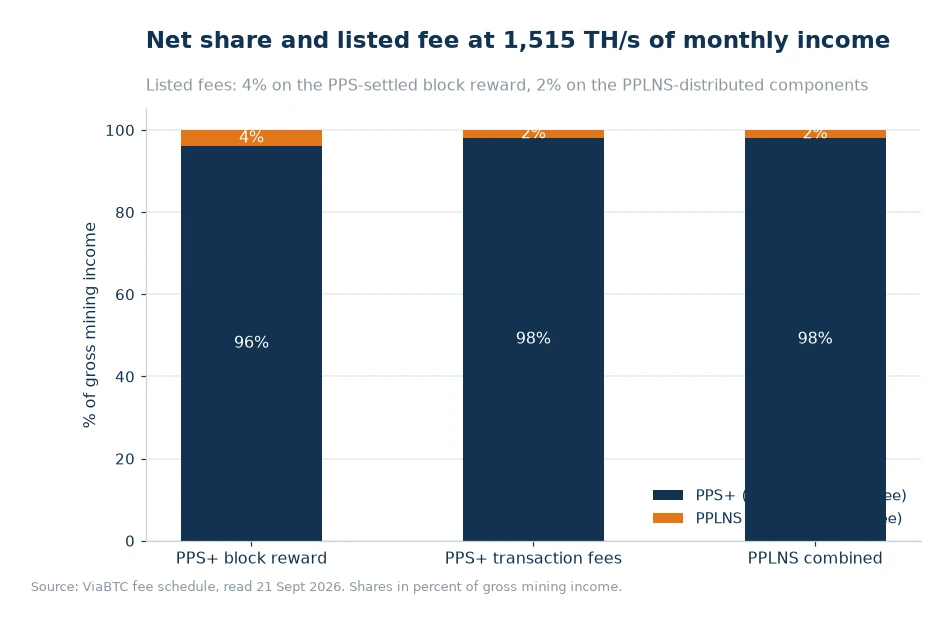
Phone dashboards are good at telling you that nothing is on fire and bad at telling you what a fee costs. At 1,515 TH/s the gross runs $57.56 a day, the listed 4% on the block-reward component takes $2.30, and the listed 2% line takes $1.15. Those are the numbers worth pinning to a screen, because everything else on a mobile app is a status light.
Key takeaways
- 1,515 TH/s earns 0.00067964 BTC a day, or $57.56 at $84,692 per BTC.
- The listed 4% on the block-reward component is $2.30 a day, and the listed 2% line is $1.15.
- A week of the 4% line is $16.12; a 30-day month is $69.07.
- The hourly deduction is about ten cents, which is why a fee only makes sense at weekly scale.
Three figures that fit on one screen
A useful mobile view needs three numbers: hashrate, balance and the deduction rate applied to this account. Most apps show the first two and leave the third buried in a statement, which is how operators end up reading a percentage off a marketing page instead of their own invoice. The three figures are enough to answer the only question that matters on a phone — is the account behaving as expected?
Everything else can wait for a desk. Fan curves, per-board temperatures and pool latency are diagnostic tools, not commuting companions. Checking them on a five-inch screen at a bus stop produces anxiety without producing a decision, and a small operator with one rack has enough of both already. The phone is best used as a summary device and a pager; the diagnosis can wait until there is a keyboard in front of you.
The percentage on the app is not the deduction
PPS+ applies a listed 4% to the PPS-settled block reward and a listed 2% to the transaction-fee component, which is distributed on PPLNS logic. An app that shows "fee: 4%" is describing one line of two, and a reader who multiplies the balance by 4% will be wrong in both directions depending on the month's fee mix.
The reliable method is to subtract: record the gross, record what arrived, divide the difference by the gross. At 1,515 TH/s that gives 2.30 ÷ 57.56 = 4.0% when the window is pure block reward, and something slightly lower when transaction fees are heavy. Doing the subtraction once a week teaches you more about the rate card than reading it ten times.
What a 1,515 TH/s account pays in a week
Daily figures are too small to feel and monthly figures are too far away to act on. A week is the interval where a change is visible and a correction is still cheap. Seven days at this hashrate is 0.00475750 BTC, or $402.92, and the 4% line takes $16.12 of it.
Sixteen dollars is not a crisis. It is, however, roughly the cost of a replacement fan and a few hours of a technician, which makes it a useful unit for comparison. When a pool offers a different rate, the question is whether the difference over a week pays for the switch in time and risk. Framed that way, most rate changes are smaller than the effort of moving.
The ViaBTC Pool Fees schedule is short enough to check against the weekly subtraction directly. If the two agree, the account is being charged what the page says. If they disagree by more than a few percent, the difference is almost always the fee mix rather than an error, and the statement will name the component once you look for it.
There is one more reason a week works better than a month for this check. Fee changes and scheme changes are usually announced before they apply, and a weekly reader sees the effect immediately rather than discovering it in a total that also contains three unrelated weeks. The habit costs a few minutes and removes the main source of unpleasant surprises.
Notifications beat refreshes
The best thing a phone can do for a mining account is tell you when something breaks. Set a hashrate floor and a temperature ceiling, then stop opening the app. A worker that drops below the floor for two consecutive settlements is worth a notification; a balance that is ten cents lower than yesterday is not.
Notifications also make the fee review easier. If the only interruptions are real events, then a quiet week is evidence that the fee you paid was for uninterrupted service. A week full of alerts is evidence of something else, and the credit total will confirm it. The two records together tell a story that neither one tells alone.
Choose the threshold with the fee in mind. A 1% hashrate dip costs about $0.58 a day at this size, which does not justify a notification at three in the morning. A 20% dip costs about $11.51 and probably does. Set the floor somewhere between the two and accept that the alert is a triage tool rather than a meter.
A week of small numbers
The table scales one rate up across four periods so the size of the deduction becomes intuitive rather than abstract.
| Period | Gross | Listed 4% line | Listed 2% line | Net after 4% |
|---|---|---|---|---|
| One hour | $2.40 | $0.10 | $0.05 | $2.30 |
| One day | $57.56 | $2.30 | $1.15 | $55.26 |
| One week | $402.92 | $16.12 | $8.06 | $386.81 |
| Thirty days | $1,726.81 | $69.07 | $34.54 | $1,657.74 |
The hourly row explains why fee anxiety is misplaced. Ten cents an hour is below the resolution of most decisions, and yet it is the row people stare at when they open the app at midnight. The weekly row is the one that belongs in a budget.
Worked example: two days of fee at 1,515 TH/s
A 48-hour window is long enough to average out settlement timing and short enough to finish before the phone battery does.
- Each terahash returns 450 ÷ 1,003,000,000 = 0.00000044865 BTC a day.
- At 1,515 TH/s the account sees 0.00067964 BTC.
- In dollars: 0.00067964 × 84,692 = $57.56.
- Doubling the window gives $115.12 of gross, or 0.00135928 BTC.
- Four percent of the two-day gross is $4.60.
- Two percent of the same gross is $2.30.
- Subtracting the first leaves $110.52 net over 48 hours.
- An hour on its own: 57.56 ÷ 24 = $2.40, with about $0.10 deducted.
The two-day totals are the ones worth screenshotting. They fit on a phone, they survive being compared with the next two days, and they are large enough that a ten-cent rounding error does not change the conclusion.
Frequently asked questions
How much is the fee per day at 1,515 TH/s?
$2.30 a day on the listed 4% block-reward line against $57.56 of gross, or $1.15 if the window sits on the listed 2% PPLNS-distributed base instead.
Why does the app not show the fee as a dollar figure?
Most dashboards show a rate rather than a deduction, so the dollar amount has to be derived; subtract the credit from the gross and the result is the fee actually applied to that window.
Is a weekly review often enough?
For fee purposes yes, because a week covers $402.92 of gross and makes the $16.12 deduction visible, while an hourly view shows about ten cents and teaches nothing.
Set the alert, then close the app
The phone is a monitoring tool, not a control room. Configure one hashrate alert and one temperature alert, review the fee weekly, and leave the rest to a desk with a spreadsheet. If you want the numbers on the go, the ViaBTC app covers iOS and Android with live hashrate and alerts, and the multi-currency wallet is where the net figure lands when you decide to move it. Neither replaces the weekly subtraction, but both make it easier to skip the midnight refresh.
Listed percentages from the pricing page[1]. Chain data read 21 Sept 2026: 132.76 T difficulty, 1,003 EH/s network, 3.125 BTC subsidy, 144 blocks daily, BTC $84,692. Period figures scale one uninterrupted day. Published 24 Oct 2026.