Time Management for Adult AI Chat
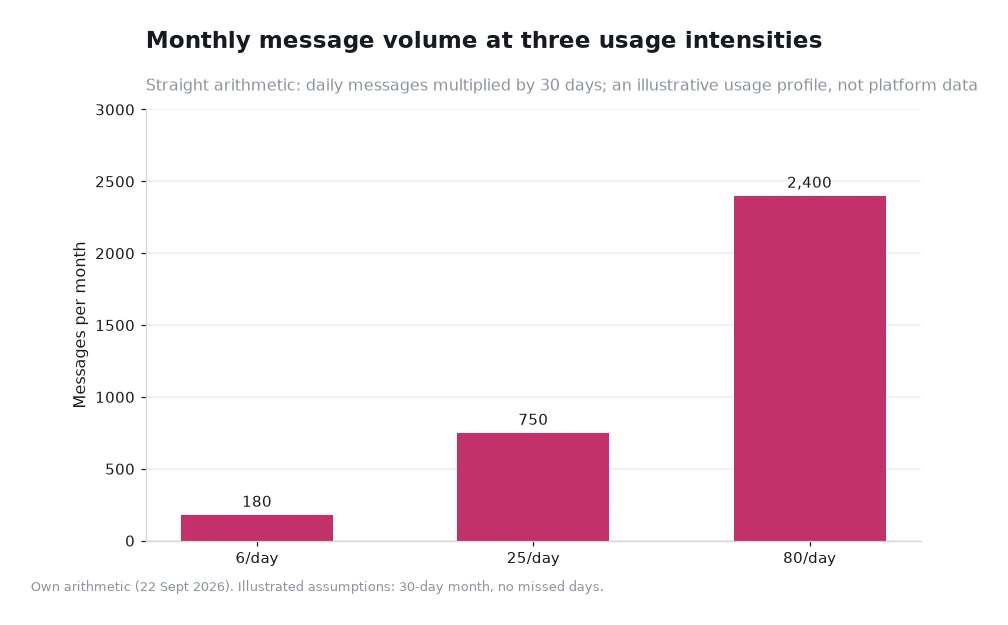
The number that governs an adult chat habit is not messages, it is minutes, and minutes are only visible once you write them down. A light pattern of 6 messages a day comes to 180 in a 30-day month; at a rough working assumption of about a minute per message, that is three hours a month, or 45 minutes a week. Crushon describes its Sex AI companions as adapting to your personality and remembering your preferences, which is exactly what makes a minute budget easier to spend well than a vague intention to use it less.

Key takeaways
- Budget in minutes per week, not in sessions or messages: 6 messages a day is 180 a month, close to 45 minutes a week at one minute per message.
- Convert sessions into time before you book them, because a session with a stated length is the only kind you can hold to.
- Track one number — minutes — for four weeks; anything more elaborate gets abandoned by week two.
- Set the budget against your week, not your month. Monthly totals hide the weeks that got out of hand.
Why minutes are the right unit
Messages and sessions are noisy units. A session can be eight messages or eighty, and both look like one line in a log. Minutes behave better: they are finite, they compete directly with other parts of your week, and a weekly ceiling in minutes is a number you can actually check without opening the platform.
The conversion is straightforward once you fix an assumption. Take one minute per message as a working estimate: it is a simplification, since some messages are one line and some are a paragraph, but it is close enough to be useful for budgeting. Under that assumption a light month of 180 messages costs about 180 minutes, or three hours spread across four weeks. A steady month of 750 messages costs roughly 750 minutes, or 12 and a half hours. A heavy month of 2,400 messages costs around 2,400 minutes, which is about 40 hours — a figure that would be an entire working week.
Those three bands are the useful part of this article. Most people who feel their habit has grown are not in the first band any more, and the difference between the second and third band is not a matter of taste; it is a matter of what else the week had room for.
A weekly ledger that takes two minutes
Tracking works better when it is small. Write four fields per week: the number of sessions, the average session length in minutes, the week's total, and one word about how it felt. That is it. The ledger's job is not analysis; it is to make the week visible before it becomes a month.
| Level | Sessions per week | Minutes per session | Weekly total | Monthly equivalent |
|---|---|---|---|---|
| Light | 3 | 15 | 45 minutes | About 3 hours |
| Steady | 4 | 30 | 2 hours | About 8 hours |
| Heavy | 6 | 70 | 7 hours | About 28 hours |
| Over budget | 9 | 90 | 13.5 hours | More than a part-time week |
The rows are deliberately blunt. The heavy row is the one to watch, because seven hours a week is a real commitment that will crowd out something else, and it rarely arrives as a decision. It arrives as a session that ran long three times.
Worked example: from messages to a weekly ceiling
Start from the chart's three intensities and convert each one into minutes and sessions. At 6 messages a day the month holds 6 × 30 = 180 messages, which at one minute per message is 180 minutes, or 45 minutes a week. At 25 messages a day the month holds 750 messages, about 750 minutes, or roughly 3 hours a week. At 80 messages a day the month holds 2,400 messages, about 2,400 minutes, or ten hours a week.
Now pick the ceiling you want rather than the one you have. If two hours a week is the honest budget, then the arithmetic says two hours is 120 minutes, which at a 30-minute session is four sessions a week, or about 17 messages a day. That last figure is the useful one: a 17-message daily ceiling is a concrete number you can hold to on a Tuesday evening, whereas "less scrolling" is not.
Check the ceiling against what you actually used at the end of each week rather than each month. Monthly totals average away the bad weeks, and the bad weeks are where habits are formed. The volumes and the one-minute assumption are the author's illustrative arithmetic, not platform data, and a 30-day month with no missed days is a simplification.
Practical levers when the week runs over
Three levers usually fix an over-budget week, and none of them require giving anything up permanently. The first is session length: cutting a session from ninety minutes to thirty reduces a week by three hours on its own if you run six sessions. The second is session count, which is easier to control than length because it is decided before you start rather than during. The third is the opening message: a session that starts with a premise tends to conclude at a natural point, while a session that starts with nothing to do tends to run until fatigue.
The reference point for how the experience is framed sits on the platform's own page for https://crushon.ai/ai-sex-chat, which describes the adaptation and recall built into the characters. Knowing that context is stored is what makes shorter sessions viable: a thirty-minute session that picks up an established thread carries further than a ninety-minute session that starts cold.
If you want to compare your own pattern with what other readers do, the character search view is a better reference than any figure quoted here, since it shows what the catalogue actually contains rather than what a budget assumes, and the AI chat blog covers the mechanics of sessions and memory. Budget from your own ledger, and use the catalogue to decide what to spend it on.
Frequently asked questions
How many minutes a week is normal?
There is no normal, but a light pattern of three 15-minute sessions is 45 minutes a week, and a heavier one of six 70-minute sessions is seven hours. The useful question is which of those fits your week rather than which is typical.
Should I track messages or minutes?
Minutes. Messages are an input to time, and time is the resource that competes with everything else in your week. If you must track a second number, track session count, because it is the easier one to change.
Why does a monthly review not work?
Because it averages. Two heavy weeks and two light ones look acceptable in a monthly total, while the weekly ledger shows you exactly which weeks went over and what pattern caused it.
Does a shorter session feel worse?
Usually not, if the session has a premise and the character retains context. Shorter sessions tend to feel sharper, and they end because you decided to stop rather than because you ran out of energy.
Write the ceiling, keep the ledger
Pick a weekly ceiling in minutes, convert it into a daily message figure, and write both at the top of a note. Then record four numbers a week for a month.
By the fifth week you will know your real pattern rather than your assumed one, and a budget based on that is the only kind that holds.
Data and sources: platform pages describing Sex AI companions, adaptation and memory, read from Crushon.AI on 22 Sept 2026[1]. Message volumes and the one-minute-per-message assumption are illustrative arithmetic by the author and are not platform data. Intended for adults aged 18 or above.