Small Brewery Start-Up Costs: Where the Budget Usually Goes
Most of a small brewery's equipment budget lands in two places: the vessels that make wort and the vessels that hold it afterwards. The only published price frame on the supplier's site is the 10 BBL example, US$75,000 to US$200,000 for a complete system before valves, pipes, steam boiler and site-specific extras. Every percentage below is a labelled planning estimate of my own, useful for a budget sheet rather than for a quotation.

Key takeaways
- The brewhouse vessels normally take the largest single share of equipment spend, with fermentation and bright tanks close behind.
- Cooling, cleaning and control are separate lines, not extras inside the vessel price, so they belong in the budget sheet from month one.
- Installation and freight are distance-driven lines; on a container shipment they compete for space with tanks that could otherwise be stacked inside each other.
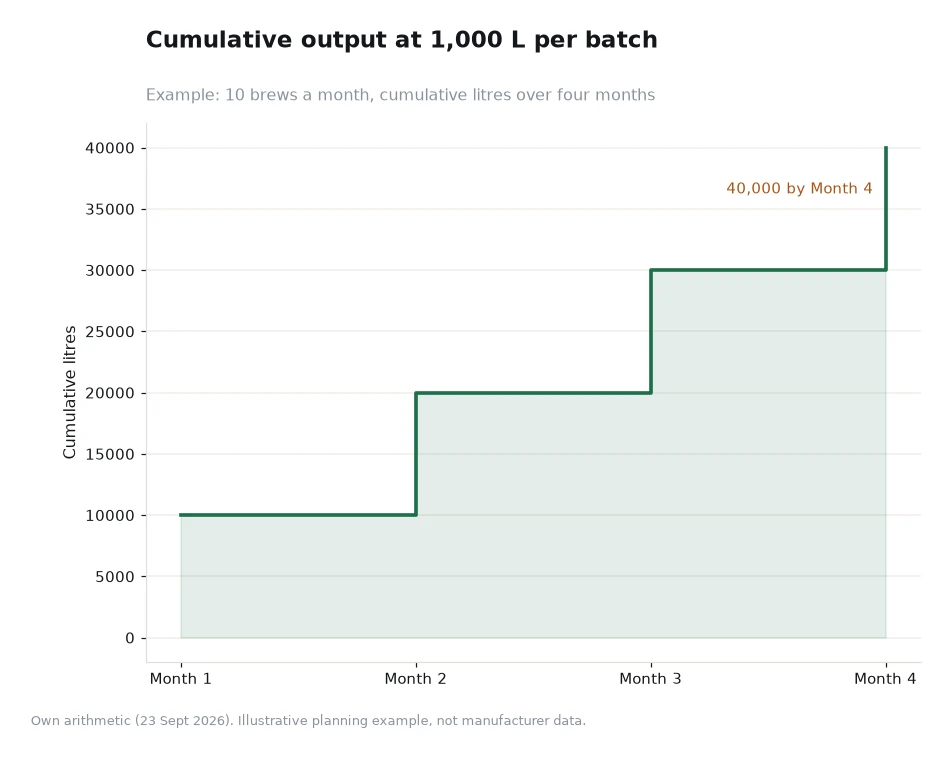
- Output decides whether the budget works: 10 brews a month at 1,000 L is 40,000 L after four months, the cumulative ramp plotted below.
Where the money actually goes
A start-up budget sheet is easier to argue about when it is split by function rather than by invoice. Four blocks cover almost everything on a small brewery order: the hot-side vessels, the fermentation and storage vessels, the cooling and control equipment that keeps temperature steady, and the packaging and handling equipment that gets beer into a container. Freight and installation ride on top of all four, and they are usually quoted last, which is exactly why they surprise first-time buyers.
Hermann has been building craft brewing equipment for 23 years and sells through a range that starts at a 200 L nano set and runs up to a 10,000 L system, with turnkey projects handled from business plan through to installation. That range matters for budgeting, because the same budget can buy a larger single vessel or a smaller set with better control, and the two choices behave very differently in year one.
The single published price point to anchor a conversation is the 10 BBL example range of US$75,000 to US$200,000 for a complete system, before valves, pipes, a steam boiler and other site-specific requirements. A spread that wide is not a lack of information; it is the honest consequence of three decisions that change the order completely: how many vessels the brewhouse has, how it is heated, and how much of the process is automated.
A planning split you can defend
The percentages in the table are my own planning estimates, not manufacturer figures. They are built for a small brewery buying a complete system in one order, and they should be replaced with real numbers as soon as two quotations exist.
| Budget line | Planning share | What it covers |
|---|---|---|
| Hot-side vessels | 30 to 40 per cent | Mash and lautering vessel, kettle and whirlpool, hot water tank |
| Fermentation and bright tanks | 20 to 30 per cent | The tanks that set your tank turns and your cold-side capacity |
| Cooling and control | 8 to 12 per cent | Glycol, chiller, jacket pipework, control panel |
| Packaging and handling | 8 to 15 per cent | Filling, kegging and the tanks, kegs or casks that move beer out |
| Installation and freight | 10 to 20 per cent | Sea and inland freight, unloading, piping up, commissioning |
Two rules keep the split honest. First, never let the vessel budget consume the cooling budget: a brewhouse with no reliable way to crash-cool wort is a brewhouse that cannot brew twice in a day. Second, keep a contingency line that is not a percentage of anything, because a site that discovers a drain in the wrong place usually discovers it while the tanks are already on the floor.
Why the vessel count moves the budget
A brewhouse offered in two, three or four vessels is not the same purchase at different prices. Each extra vessel adds a shell, a jacket, a set of valves and a run of pipework, and it also changes the shape of the working day. Buyers who work through that decision first usually find the rest of the budget easier to set, because vessel count tells them how many brews a day the site can realistically sustain and therefore how many fermentation tanks they need to buy with it.
Heating is the second lever. A steam-heated kettle asks for a boiler and a steam system, direct firing asks for different ventilation and floor protection, and electric heating trades capital cost against the electricity supply available at the site. None of the three is universally right; what matters is that the choice is made with the building's services in hand rather than after the order is placed.
Installation, freight and the costs people forget
Freight is quoted by volume as much as by weight, and small vessels ship better than large ones because they can be nested and boxed more tightly. That is one reason a start-up sometimes buys two 1,000 L vessels instead of one 2,000 L vessel, even when the larger single vessel looks cheaper on paper.
On the site side, three lines are routinely underestimated: the floor and drain work, the electrical supply and the water treatment. None of them appear on a brewery quotation, and all three can delay a commissioning date. The published delivery window runs 90 to 150 days from deposit to door, which is enough time to finish that work if it starts when the order is placed.
Worked example
Worked example, with the assumptions written down. A 1,000 L brewhouse brews 10 times a month, and the plan runs for four months. Arithmetic: 1,000 L multiplied by 10 brews gives 10,000 L a month. Cumulatively, month one ends at 10,000 L, month two at 20,000 L, month three at 30,000 L and month four at 40,000 L, which is exactly what the chart below plots.
Convert the four-month total using the published conversion of 1 BBL at about 117 L: 40,000 divided by 117 is roughly 342 BBL of gross kettle volume, or about 85 BBL a month by month four. Those figures are labelled planning arithmetic, not manufacturer data.
Now apply a budget split to the same plan, keeping the arithmetic in percentages because the only price the supplier publishes is the 10 BBL range. If hot-side vessels take 35 per cent, fermentation and bright tanks 25 per cent, cooling and control 10 per cent, packaging 12 per cent and installation and freight 18 per cent, the five lines sum to 100 per cent of the equipment and delivery budget. Move the packaging line to year two and 12 points stay unspent in year one, which is the difference between a budget with slack and a budget that cannot absorb a lost week. The percentages are mine; the litre and barrel conversions follow the published conversion factor.
Frequently asked questions
How much does a small brewery system cost?
The only price the manufacturer publishes is a range of US$75,000 to US$200,000 for a complete 10 BBL system, before valves, pipes, steam boiler and site-specific extras, and the position inside that range depends on vessel count, heating method and level of automation.
What is usually left out of a small brewery budget?
Floor and drain work, the electrical supply, water treatment and the local cost of unloading and piping up are the lines that get left out most often, because none of them appear on the equipment quotation itself.
Building the budget in the right order
Set the output target first, then the vessel count, then the heating method, and only then collect prices. The published size list from 200 L to 10,000 L is a useful filter at that stage, and the brewery equipment range groups the vessels, cooling and packaging lines that a budget has to cover. Once the configuration is fixed, ask for the freight and installation scope in writing through the contact page. The hem beer equipment overview is the quickest way to see how the manufacturer divides the range before you divide the money.
Figures here come from the manufacturer's own website, read 23 Sept 2026: the 23 years of experience, the size range from 200 L to 10,000 L, the turnkey scope, the 90 to 150 day delivery window, and the published 10 BBL price range of US$75,000 to US$200,000.[1] The budget percentages and the four-month output arithmetic are labelled planning estimates written for this page.