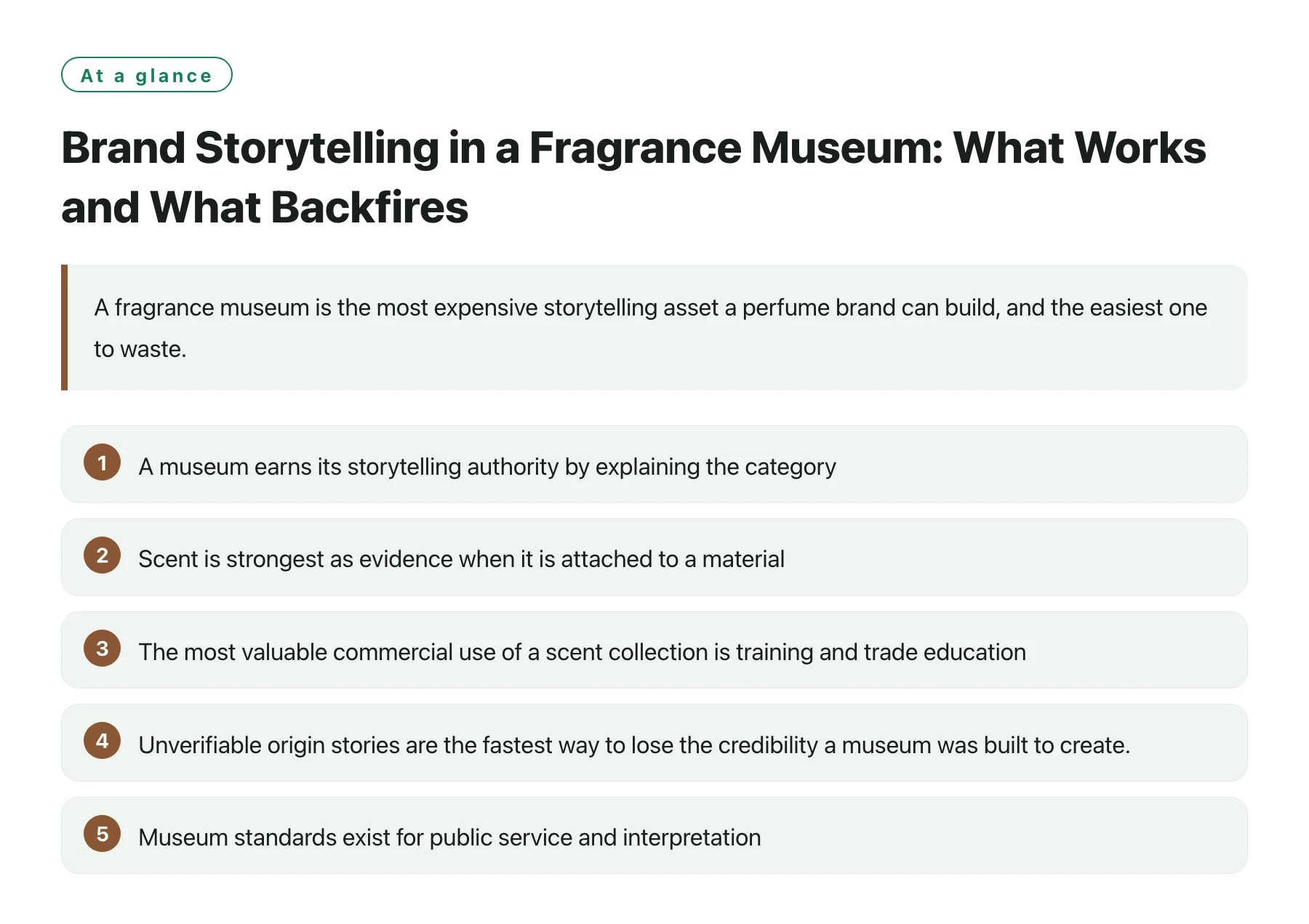
A fragrance museum is the most expensive storytelling asset a perfume brand can build, and the easiest one to waste. Used well, it turns abstract claims about craft and provenance into something a visitor can smell and handle. Used badly, it becomes a showroom with a ticket desk, and visitors recognise the difference within about ten minutes, which is a high price to pay for a piece of content a website could have carried.
Key takeaways
- A museum earns its storytelling authority by explaining the category, not by praising one brand within it.
- Scent is strongest as evidence when it is attached to a material, a process or a place rather than to a product claim.
- The most valuable commercial use of a scent collection is training and trade education, because it changes how staff and partners describe products.
- Unverifiable origin stories are the fastest way to lose the credibility a museum was built to create.
- Museum standards exist for public service and interpretation, and following them is what separates a cultural asset from a marketing suite.
Ask a marketing team what a museum would do for the brand and the answer usually involves visitors, photographs and a distinctive experience. Ask what it would let the brand say that it cannot say anywhere else, and the answer becomes vaguer.
That second question is the one that decides whether the investment works. A collection of materials, historical objects and processes gives a brand a way to demonstrate things that written copy can only assert: that the company knows how a material behaves, where it comes from, and why a formula was built the way it was.
This article looks at what a fragrance museum can credibly carry, how brands use one for education and trade storytelling, and the failure modes that turn a cultural asset into a sales floor. It is written for brand and marketing leads who are considering or already operating a museum, and who want the narrative to survive contact with a sceptical visitor.
What a scent collection can say that a website cannot
Digital content is good at describing and poor at demonstrating. A museum inverts that: it is poor at reach and strong at proof, because the visitor can smell the material, see the process and handle the object.
Three kinds of narrative benefit most from that physicality, and all three are about the category rather than about a single product.
Material provenance
A raw material shown in its original form, next to the extraction it produces and the accord it becomes, explains a supply chain in a way no diagram manages. The visitor learns why a material is expensive, or difficult, or variable, by experiencing it.
That lesson transfers directly to product understanding. A customer who has smelled the difference between two qualities of the same material is far more receptive to a price explanation later.
Process and craft
Manufacturing is invisible in most fragrance marketing, which leaves a gap that competitors fill with adjectives. A museum can show compounding, resting and finishing as real operations with reasons behind them, and that turns a claim about care into something observed.
It also gives staff a shared reference. A guide who has explained the resting stage a hundred times becomes a better product trainer than any slide deck.
Category history and cultural context
Perfumery has a long history and many traditions, and a museum can place a brand inside that history rather than at the centre of it. That framing is more persuasive than self-praise, because it gives the visitor a reason to trust the institution's other statements.
Museum practice has developed standards for interpretation and public service precisely because credibility is the asset being protected [1]. A brand-run museum that follows those conventions borrows some of that credibility, and one that ignores them borrows nothing.
Building a storytelling programme around the collection
- Write the story the collection can proveList the claims the brand wants to make, then mark which ones the museum can demonstrate rather than assert; those become the programme's spine.
- Design the route around three ideas, not thirtyVisitors retain very little from a dense route, so choose a few ideas and let every station support one of them.
- Separate the educational content from the commercial contentKeep the explanation of the category independent of the product pitch, and let the pitch happen in a clearly separate space.
- Build the trade and staff programme firstTrade visits, staff training and partner education produce measurable value sooner than general visitor traffic does.
- Create a content pipeline with permissionPhotography, video and interviews made at the museum are cheaper than studio production, but agree rights and releases before the visit rather than after.
- Measure what visitors retainedAsk departing visitors to name one material and one idea, and treat the answers as the programme's real output metric.
The line between a museum and a showroom is not the ticket price, it is the direction of the explanation. A showroom explains why you should buy this product. A museum explains why this material, this process or this tradition matters, and lets the visitor draw the conclusion. Cross the line and two things happen at once: visitors discount everything they were told, and the collection loses the cultural authority that made it worth building. When you are reviewing the route, count how many stations end in a product rather than in an idea. If most of them do, you have built a showroom with better lighting.
Storytelling uses, ranked by what they return
| Use of the collection | What it produces | Main risk |
|---|---|---|
| Staff and guide training | Product fluency and consistent language across retail and support teams | Training decays without a refresh cycle and a written reference |
| Trade and partner visits | Deeper relationships and better-informed buyers, with a reason to return | Turning the visit into a sales presentation and losing the effect |
| Education programmes and courses | Long-term credibility and a pipeline of informed practitioners | Teaching simplified material that is not actually accurate |
| Press and content production | Visual and editorial assets at low marginal cost | Rights and permissions agreed too late to be usable |
| General visitor traffic | Awareness and word of mouth beyond the category | Volume pressure pushing the experience toward entertainment |
| Origin and heritage narrative | Emotional context for the brand and its materials | Unverifiable claims that undermine everything else |
The order in the table is deliberate. Uses that change what people inside and around the business can say tend to pay back faster than uses that chase reach, and they are also the ones that keep the collection honest, because staff and trade visitors ask harder questions than casual visitors do.
The failure modes worth planning against
Brand-run museums fail in predictable ways, and most of them are marketing decisions rather than curatorial ones. Naming them in advance is cheaper than correcting them after opening.
Three are common enough to plan for explicitly.
Every room ends in a product
When each station resolves into a commercial message, the visit becomes a lengthy advertisement and the educational content reads as bait. The correction is structural: give the explanation its own space and time, and put the products where a visitor expects to find them.
A useful test is whether a visitor who buys nothing still leaves having learned something specific. If not, the programme is a sales channel wearing a museum's clothes.
History the brand cannot support
Origin stories are tempting and dangerous. A claim about a founder, a date, an invention or a first is verifiable, and a single unverifiable claim casts doubt on the rest of the exhibition.
Write only what the collection, the archive or a citable source can support, and treat an honest gap as part of the story rather than as a weakness. Industry bodies that support perfumery education and the profession take a similar view of accuracy, because the audience for craft content is often knowledgeable [2].
A visit that only works for one audience
A route designed for trade buyers is usually too long and too technical for a family, and a route designed for casual visitors often leaves professionals unsatisfied. Running one route for everyone produces a compromise that serves neither group well.
Design two shorter routes rather than one long one, and tell each audience in advance what it is getting. That decision also makes the collection more useful internally, because a working manufacturer's museum can double as a teaching resource for the people who develop products.
A collection attached to a working fragrance business, such as the one XUELEI operates in Guangzhou, has that advantage built in. The material knowledge on site is current rather than reconstructed, and that is exactly what makes the storytelling credible.
Sources
- ICOM — International Council of Museums —— The international organisation representing museums; publishes the ICOM museum definition and professional standards for museum practice.
- The Fragrance Foundation —— A non-profit organisation for the fragrance industry, running perfumery education programmes and industry recognition.
Frequently asked questions
Should a perfume brand build its own museum?
Only if it can support an educational programme rather than a product showcase. A museum pays back through training, trade education and credibility, and those require staff time and accurate content. If the goal is purely promotional reach, a showroom or an experience centre will achieve it at lower cost and with less reputational exposure.
How do you keep a brand museum from feeling like advertising?
Separate the explanation of the category from the promotion of products, and let stations resolve into ideas rather than purchases. Give the educational content enough time to be genuinely useful on its own. If a visitor who buys nothing still learns something specific, the balance is probably right.
What can a fragrance museum do for retail staff?
It gives them a shared, physical reference for materials, processes and product differences, which improves how they describe products to customers. The effect fades without reinforcement, so pair the visit with a written reference and a periodic refresher rather than treating it as one-off training.
Is it acceptable to display products in a scent museum?
Displaying products is normal in a museum attached to a manufacturer, provided the educational content stands on its own. The problem is not the presence of products but the absence of anything else. Context, process and material history are what allow a visitor to interpret the products they see.
How do you measure whether a museum is working?
Track what visitors retain rather than how many arrive. Ask departing visitors to name one material and one idea, survey trade partners on whether the visit changed how they describe the products, and check whether staff use museum material in their own conversations. Retention metrics are less flattering and far more informative than footfall.